One of the coolest parts of this little paradise we call Wild Air, here on the woodsy edge of the world in Tenants Harbor, is what Mainers call a ‘right of way’. It’s a strip of land, a pathway, connecting the common dirt road with the sea. It’s all stolen land from the Abenaki who lived here during their winters for thousands of years before the murderous European settler colonizers seized it all and genocided the native people.
All this violent theft was post-legitimized with granted land deeds, and the one which included the patch of land described in “our” deed is specific about the surveyed dimensions of the theft we bought (along with the bank, because-capitalism...)
The survey plots a narrow slice of land extending from the dirt-and-gravel-packed States Point Road where our cabin sits, down to the mouth of Long Cove and the northern reach of Tenants Harbor. This rough course of grass and roots, tunneling through the second growth canopy of reaching poplars, birches and oak leads down to the seaside. For the past two summers I’ve happily mowed and tried to tidy it for any and all to use for putting in their kayaks and digging the easy lap of high tides which, depending on the moon’s pull, sometimes reach right up to its grassy edge.
The OG nomads of the Abenaki tribe would be ironically pleased perhaps that, although this piece of land is somehow understood as “ours” (Sandy and mine), we see ourselves not as owners but as custodians for everybody else who wishes to enjoy it as their ‘right of way’. They’d dig it because it’s exactly how they understood all land worked in its relationship with the brief human lives traversing it. Humans didn’t own it, they shared and cared for it.
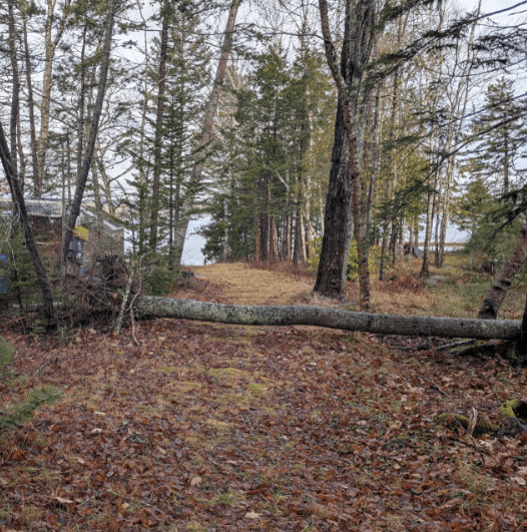
An early December storm knocked down a fairly big white polar which had been rooted for at least a hundred years just about on the exact border of our right of way and our good neighbors, Charlotte and Nick’s, piece of land where their lobstering business has their trap storage and bait fridge. We were still “away” when it happened, and our good neighbor Maggie emailed us a picture of the downed tree (see the snap above) to let us know what we missed.
The tree fell across the pathway and barely missed our neighbor Jim’s electric generator on the opposite side of the right of way. When Maggie emailed me and Jim – both of us not on St. George earlier this month – I thanked her and let Jim know I’d connect with Nick and Charlotte when I was up on December 12th and let him know our communal solve.
The solve wasn’t tricky – I texted Nick to see if he had a suitably big chain saw (mine was petite and could barely tackle saplings) and if he was up for a firewood making party. Nick said yes and today’s the day.
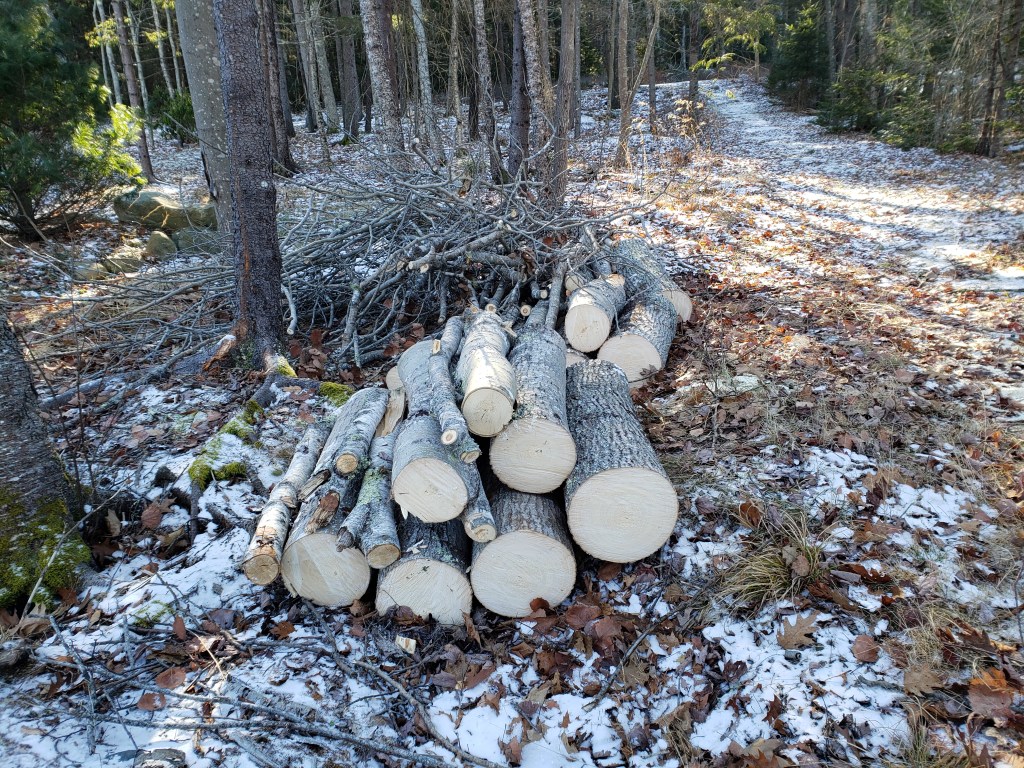
Here are two pix of our work and output…
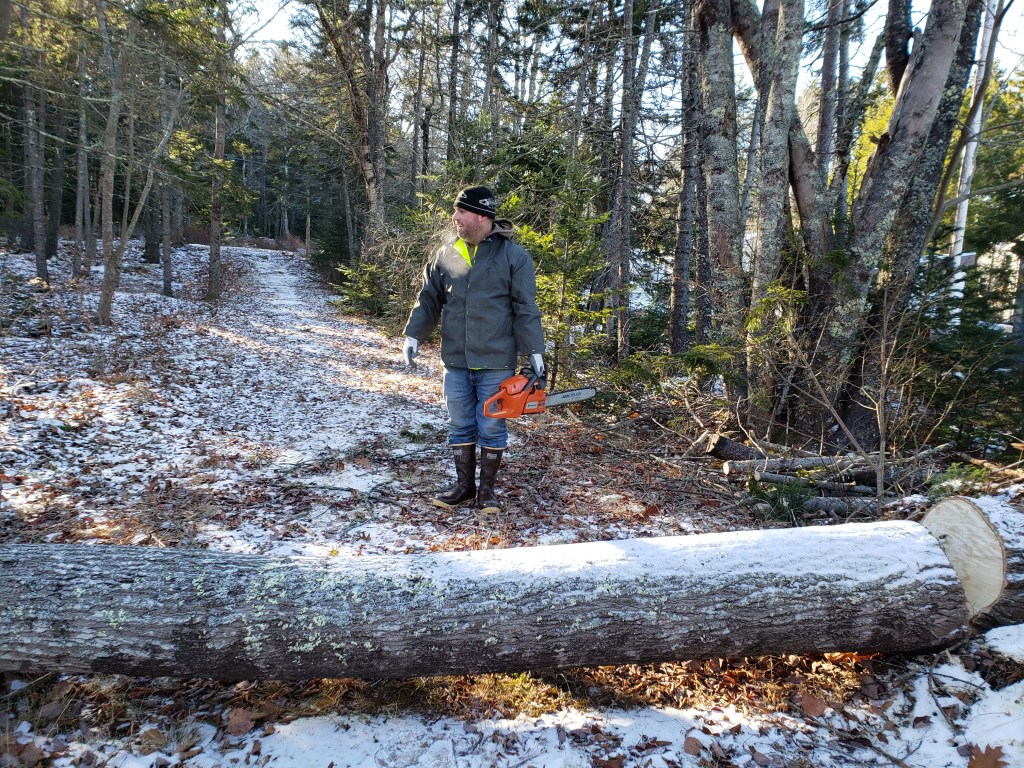
Nick saved me from cutting off any of my 69-year old fingers while I did the grunt work of lifting, rolling and stacking I was trained to do as the 18-yrold day laborer I’ve remained over the 50 years since…
These trees, whether fallen or standing, have become a weirdly integral part of my life experience whenever Sandy and I steal the sweet time to be here. Each night, I spend a few minutes standing in the dense wood right off our porch and communing with them and the dirt that connects them and me, along with the skies of various moons and glinting stars which bathe us all.
Sandy heard someone recently recommend forest bathing and, as soon as she mentioned it, I thought of how it felt to try, for a handful of minutes, to lose myself in their mix, standing between the ground and the sky. The sense of bathing is close to the remedial boost I get – but it’s not quite close enough.
I was changed forever by reading Suzanne Simard’s Finding the Mother Tree last year. In that book she – a forestry scientist – makes a case for how interdependently a forest connects itself – nourishing, feeding and caring for each other, wired together in a mychorrizal fungus network of underground pipes sluicing with minerals, water, oxygen – life.
When I stand there each night trying to lose myself in a sensing of these trees with their connecting loam and fungal networks, all lit in the shadows cast by an enlivened nightsky, I lose myself in something as infinite as it is immediate. I sense which trees seem to be leaning towards the end of their lifespans and I sense the raw pulsing juice of the smaller teenage red spruces closest to the cabin’s clearing. I flex my feet and toes through the thin leather of my shoes, seeking a tactile touching into this underground world, hungering for connection.
I thought about all this as Nick and I cut into the still living flesh of our shared fallen tree. I considered how it finally tipped and ripped the ground up from around its loyal roots and whooshed with a night-cracking blast down through the shorter more pliant birches on its way to rest inches from Jim’s generator. Here we were, changing its still sappy yellow pith into burnable-sized logs for our three home-fires, Nick, Jim, Sandy’s and mine.
I can’t help but think about the earliest tension which arose when I saw that pic above. An unease the original habitues of these wooded shores, our Abenaki forebears, would have found absurd: who owned – I knew we neighbors were all asking ourselves – the land upon which this tree toppled from, and thus who was responsible for its final disposition?
The more time I spend here amongst these trees, skies and rocky seashores the more ridiculous it seems to imagine an ownership model has anything to do with how these worlds actually work, how they thrive, how they die, how they endure. The settler colonizers who stole these lands from people who didn’t think they could be owned in the first case, are one of histories greatest criminals. I reject everything about their negation ethics of seizing, granting, exploiting and monetizing these natural beings of granite, fungus, hemlocks and bees. These men – and they were all men, first and foremost – lived for their insatiable projects of capture, of power, of control, of war and the insistent violence which fuels and connects those projects all demanding the currency of someone or something else’s death to succeed.
I think about my two daughters who visited Sandy and me here in Wild Air over the past year. Fiona just about a year ago, in a frigid January and Victoria this past sultry August. I think about them and the world of 2025+, of the men coming for their bodies with their insidious laws, their billionaire thugs, fascist slogans and massing police. I think about how all this ancient nature and these daughters and yours longing of a sisterhood to come, all gathering forces and resources towards resistance and someday, some kind of co-nurturing sustenance.
This past week I came across a short piece of writing I shared with my two daughters and Sandy’s daughter Emily. It was a 1983 commencement talk given by one of my favorite writers and philosophers, Ursula K. Le Guin, to the now-shuttered, but then vibrant, progressive and important women liberal arts college, Mills College in Oakland. Le Guin was writing in 1983 Amerika but we’re kidding ourselves if we think the world she advised those 1980s’ graduates to resist and reimagine is any different from the world we live in today. Intriguingly and provocatively, she speaks of the darkness, the earth, the below – the place where the answer to a future minus the terror of the reigning male will be birthed, nurtured, collaboratively and subversively grown and sustained…
“I hope you live without the need to dominate, and without the need to be dominated. I hope you are never victims, but I hope you have no power over other people. And when you fail, and are defeated, and in pain, and in the dark, then I hope you will remember that darkness is your country, where you live, where no wars are fought and no wars are won, but where the future is. Our roots are in the dark; the earth is our country. Why did we look up for blessing — instead of around, and down? What hope we have lies there. Not in the sky full of orbiting spy-eyes and weaponry, but in the earth we have looked down upon. Not from above, but from below. Not in the light that blinds, but in the dark that nourishes, where human beings grow human souls.”
Ursula K. Le Guin, 1983 commencement address to the graduating class of Mills College https://www.ursulakleguin.com/lefthand-mills-college
Why did we look up for blessing?… My breathe leaves me each time I read that urgent, material call-for-action. Her proscription for looking down and around is specifically against heeding, obeying and allowing the rule and laws of men to continue to limit and oppress. The earth is the country of my daughters and their futures, of their love and art, their desires fueling a particularly potent earthly happiness.
I practice and rehearse in solidarity and synchrony for that world, that earth to come for, by and with my daughters and their allies here amongst the trees – fallen, standing and yet to grow – quietly thrumming with revolutionary force. The darkness – literally the dirt, the shadows amidst the piled tailings of 150 year-old quarries, the brown-black sand and seagrass exposed twice each day to the lowering tide – this is the fecund canvas of insurgent futures where Le Guin tells us is where we must start.
It’s not a stretch to understand that fallen tree which has given of itself to our three families some future energy and warmth, as evocative of Robert Frost’s equally subversive call in his 1914 poem, Mending Wall. In that often-misunderstood ode to the latent utopian in us all, Frost tells us how this ancient system of natural forces works upon our worlds, decrying –
“Something there is that doesn’t love a wall, that wants it down…”
Frosts intuits the earth shifting in its resistance to our desperately selfish attempts of bordering, enclosing and “owning” these dark lands beneath our feet. Coming together today with Nick to cut, gather and stack that big poplar in the wild whirl of 10 degree December winds and wintering light, I felt some of that comradely call towards sensing the densening tugs of these connected earths. It somehow fed up through us both as we scrambled atop its lovely mess of rocks, and dirt, hibernating bushes and brackens of crackling twigs and sighing leaves. Fleeting, temporary men, two humans briefly entwined in ways gentle and fluid, open to and with each other and these dark worlds beneath our boots.
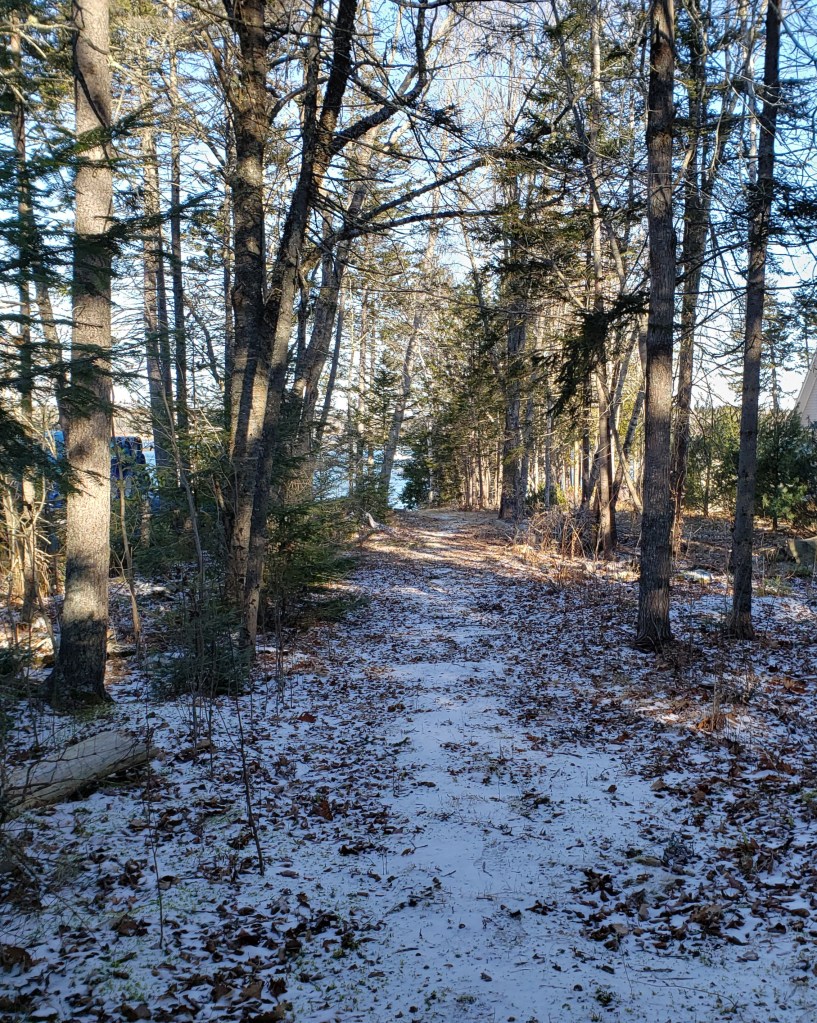
As we finished our work, I looked down the freshly cleared path to the receding sea tide, and sensed a kind of ancient, in-human connected peace out here amidst it all. We seemed to have been practicing and rehearsing getting a little more lost, a little more together, certainly less privileged players in this earthy, shared darkness where Le Guin and Frost suggest the coming movements to matter just might become born from.
 Here From Away